
Gebwell E-Flow reduced heat loss in a block of flats
The G-Power E-Flow district heating substation, installed in a 23-flat, 6,580 cubic metre block of flats in Kotka, Finland, demonstrates in practice how a heat substation’s connection solution can improve the cooling of district heating water and support the operation of energy plants’ district heating networks.
Recovering district heating energy in several stages
The operating principle of the E-Flow connection is based on utilising the energy contained in the district heating water in several stages before the water is returned to the district heating network. The energy from the district heating water is first used to heat the domestic hot water circuit and subsequently to heat the heating network. In solutions with two domestic hot water heat exchangers, the district heating water is further channelled to a second domestic hot water heat exchanger, where the heat is used to preheat the domestic hot water. In this way, more thermal energy is transferred from the district heating water before it returns to the network, resulting in a lower return temperature compared with a conventional connection solution.
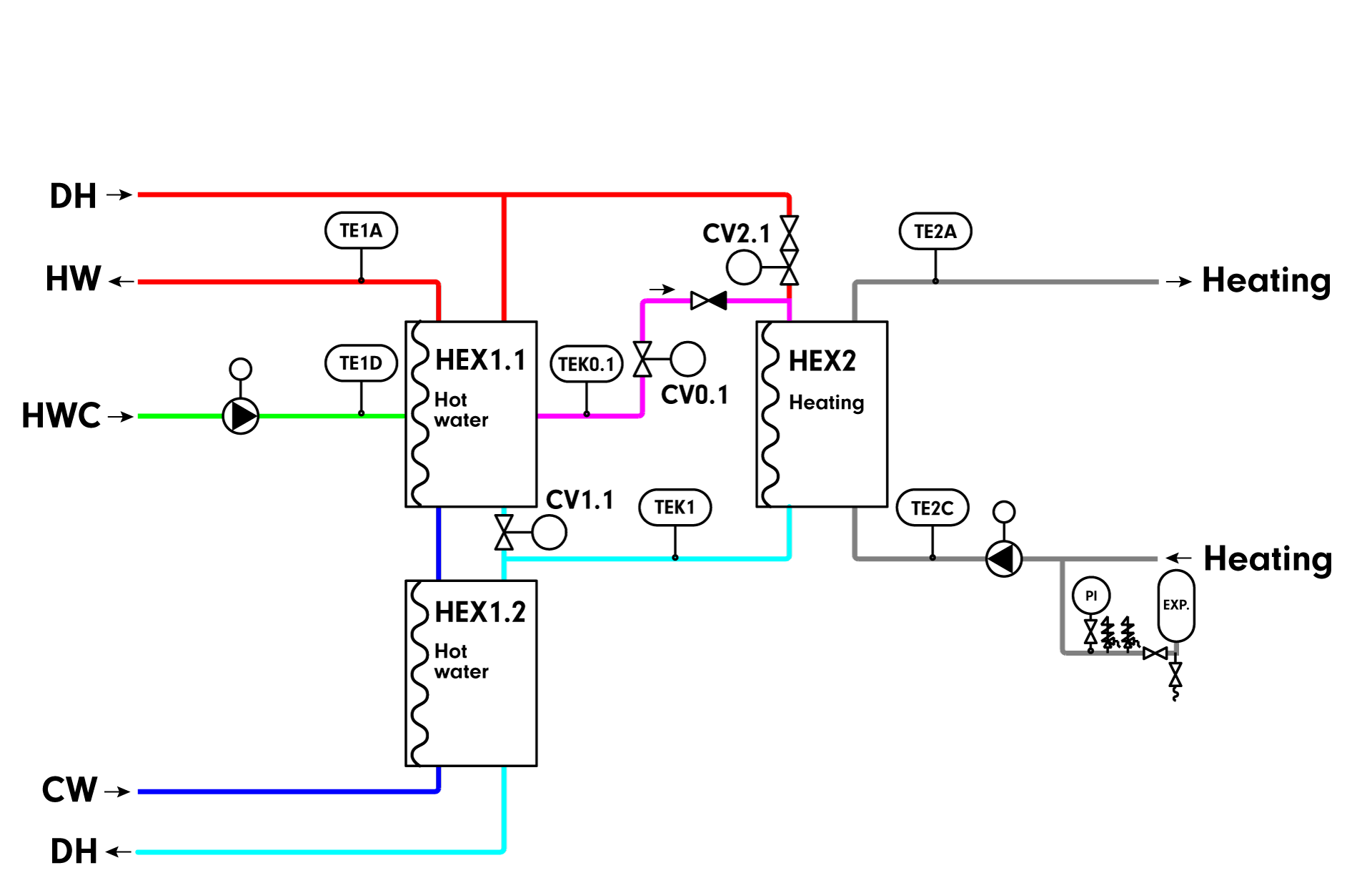
E-Flow is particularly suitable for premises where hot water consumption is high and regular, such as residential blocks of flats, hotels and care homes. In these buildings, domestic hot water accounts for a significant proportion of heating energy, and therefore the circulation solution can have a direct impact on return temperatures and the load on the network.
Cooling improved by over 9 °C during the heating season
Measurement data from the Kotka site shows that the E-Flow control system achieved a significantly better cooling effect than the traditional control system. In the monthly averages for the comparison period, conventional control produced an average cooling of approximately 41.1 °C, whilst the corresponding average for the E-Flow control was approximately 47.5 °C. The difference in favour of the E-Flow control was therefore approximately 6.5 °C on average.
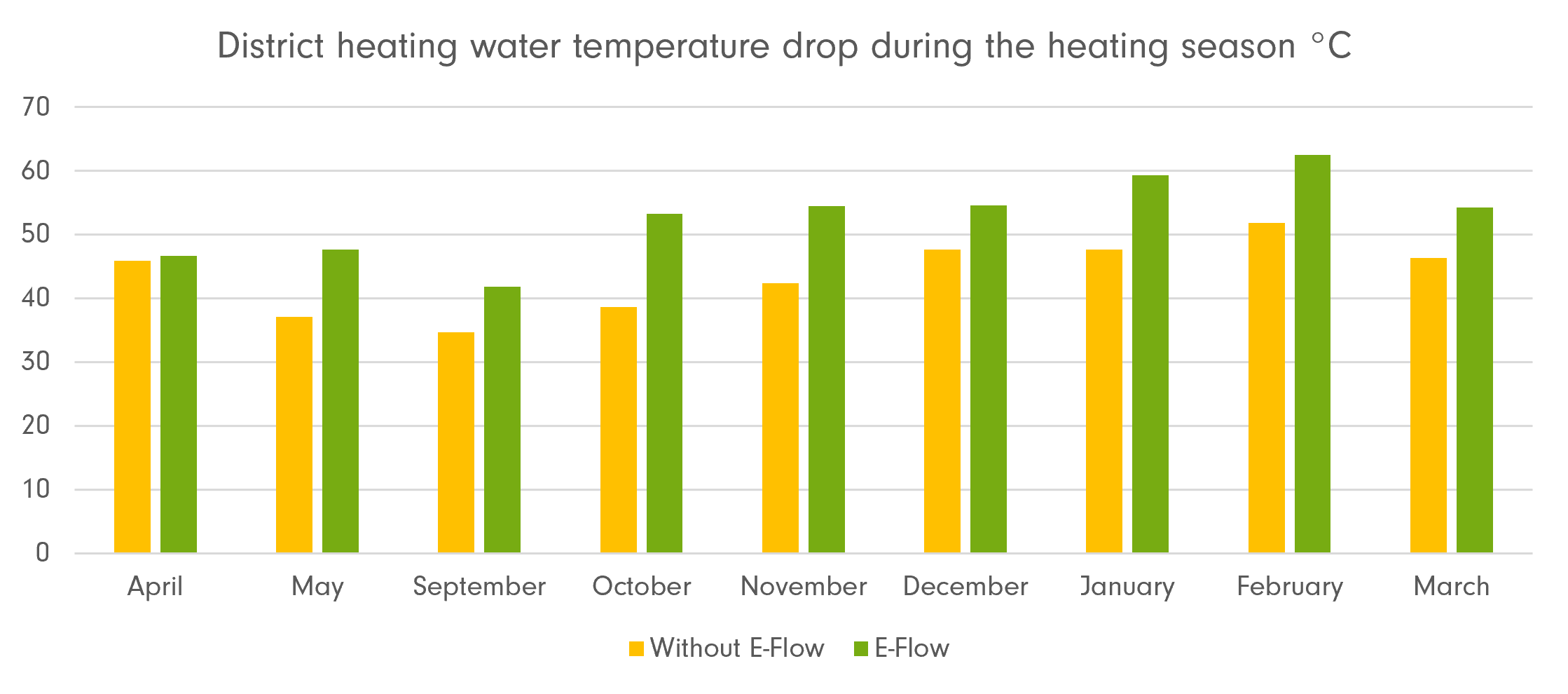
If the summer months are excluded from the reference period – during which district heating energy is not used for heating – the average cooling effect without the E-Flow connection is 43.6 °C and with the E-Flow connection 52.7 °C. The difference in favour of the E-Flow connection is therefore 9.1 °C during the heating season. The greatest benefit from the E-Flow connection is achieved during the heating season.
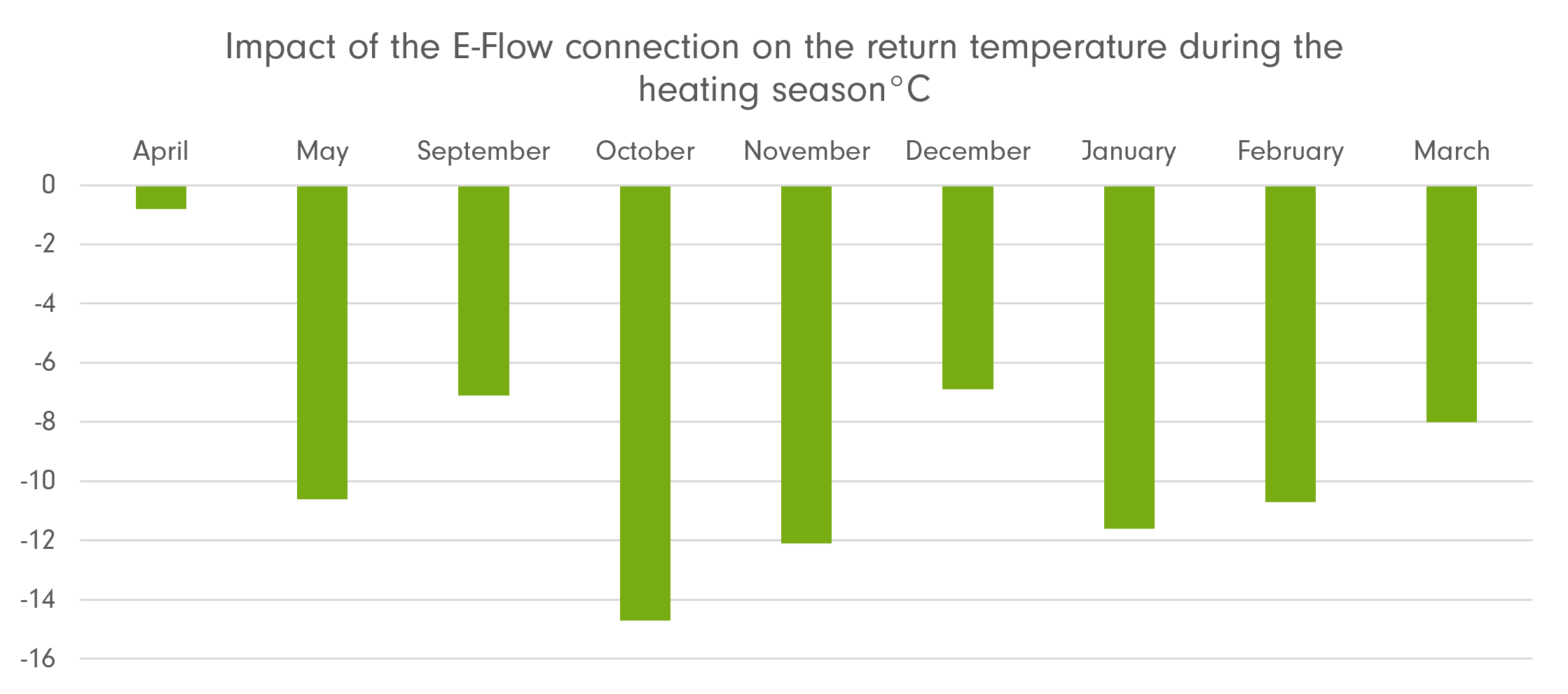
Better cooling supports the operation of the district heating network
From the energy plant’s perspective, better cooling means a lower return temperature, which supports the energy-efficient operation of the district heating system. A lower return water temperature reduces heat losses in the network, minimises the need for pumping and improves the energy efficiency of production. Furthermore, a more stable and lower return temperature supports the development of low-temperature networks and facilitates network optimisation without changes to production or network temperature levels.
This is also significant from an environmental perspective. When a district heating system operates more efficiently and the energy in the district heating water is utilised more effectively before it returns to the network, the energy efficiency of the entire system improves. Lower return temperatures support the energy efficiency of district heating production and distribution, whilst reducing unnecessary heat transfer and pumping. The impact always depends on the network and production as a whole, but better cooling is one concrete way to improve the resource efficiency of the district heating system and reduce its environmental impact.
The project in Kotka demonstrates that the heat substation’s connection solution can have a significant impact on return temperatures, even in existing buildings. E-Flow is suitable for both traditional radiator networks and low-temperature heating systems, and it offers energy suppliers a concrete way to promote the resource efficiency of the network and support the long-term development of the district heating system.
More news

EPD environmental declarations now also available for the G-Eco Core 80, Pro 120 and Pro 120 HT heat pumps
EPD environmental declarations have now also been drawn up for the G-Eco Core 80, G-Eco Pro 120 and G-Eco Pro…

Gregor Schober Appointed Export Manager for the DACH Region
Gebwell strengthens its international sales organisation and has appointed Gregor Schober as Export Manager responsible for the DACH region, covering…

Ilari Vuores appointed Product Manager for heat pumps
Ilari Vuores has joined Gebwell as Product Manager for heat pumps. In his new role, he will be responsible in…